Karaku's origins: tracing the Japanese-looking fashion brand back to China
At first glance, Karaku looks like a Japanese menswear brand.
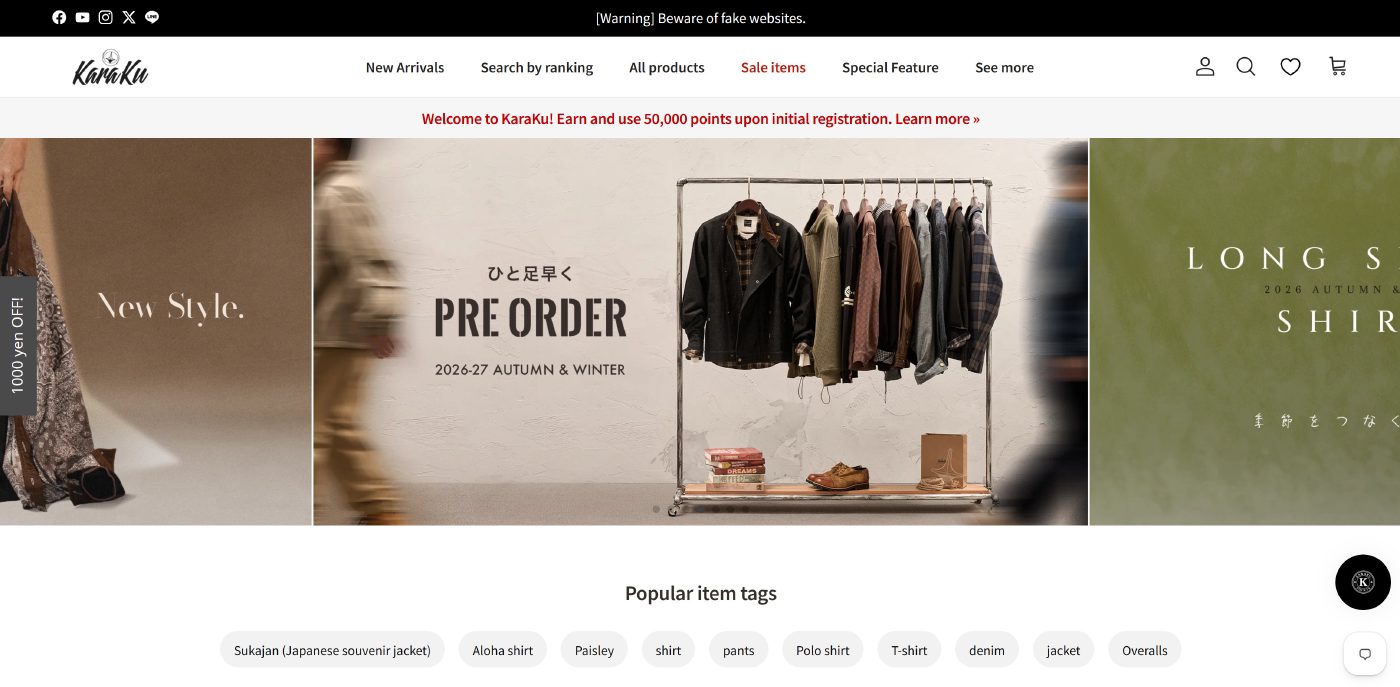
Its clothing draws heavily from Japanese interpretations of vintage Americana, workwear, and heritage fashion. It operates a flagship store in Tokyo's Harajuku area, with a Kobe store scheduled to open in September 2026. Its name is Japanese-sounding, and its marketing is filled with imagery and references that reinforce a connection to Japan.
But Karaku's corporate history tells a considerably more complicated story.
Public company filings, trademark records, and Karaku's own legal disclosures point to a business whose roots run through mainland China and Hong Kong, with Japan becoming an important operating and retail market later. Customer reports reinforce that picture: some buyers say orders ship directly from Guangzhou, garments sometimes arrive under unrelated brand names, and Karaku products have been compared with similar merchandise on AliExpress and Taobao sold at far lower prices.
Following Karaku's development over time provides further evidence of a brand deeply rooted in China's cross-border e-commerce industry.
2015: Karaku's claimed beginning
Karaku says on its own website that it was founded in 2015.
The company describes its founding team as vintage-clothing enthusiasts and professional apparel designers interested in classic American casual fashion. It says original design has been central to the company and that production is carried out in collaboration with outside factories.
What Karaku does not provide is much verifiable corporate detail about those early years. Its history page does not name the founders or identify the legal entity under which the purported 2015 business operated.
That becomes notable because the corporate entities now associated with Karaku appear considerably later.
2020: Karakubuy launches online
Karaku's own timeline says the Karakubuy online store launched in May 2020, initially with a seven-person team.
By December 2020, Karaku says it was looking for suppliers and factories and developing a quality-control system covering design, manufacturing, sales, and after-sales service.
That same period produces one of the first important mainland Chinese clues.
In late 2020, Shenzhen Jiashe Internet Technology Co., Ltd. filed U.S. trademark applications for the name PLUSHE, including apparel-related uses.
PLUSHE would later appear directly in Karaku's own legal structure.
2021: Shenzhen Jiashe and Bondot
Shenzhen Jiashe subsequently registered another name: BONDOT.
Bondot developed into a cross-border retail and brand-expansion business focused on bringing online brands into physical stores. Its own website describes a model involving store preparation, launch, ongoing operation, and expansion.
Karaku appears directly in Bondot's portfolio.
Bondot says it developed strategies to expand Karaku in Malaysia and Tokyo, targeting men interested in vintage-inspired apparel and reporting increases in brand awareness and online and in-store sales.
That wording is revealing.
Tokyo is not presented as the historical home from which Karaku expanded internationally. Bondot presents Tokyo as one of the markets into which it helped Karaku expand.
2023: a Japanese Karaku corporation appears
A Japanese company called KARAKU株式会社 was established in 2023.
Japanese government corporate data now lists its headquarters at 3-24-1 Jingumae, Shibuya, Tokyo, the same location as Karaku's Harajuku store. The government database also currently shows six insured employees associated with that location.
Karaku says its first flagship store opened there in September 2024.
Both the Japanese corporation and the Harajuku store therefore arrived years after the online brand was already operating.
2024-25: Bonitadot enters the picture
The next major piece is BONITADOT LIMITED, a Hong Kong company that became part of the corporate structure surrounding Karaku.
Bonitadot was associated with Easy Click Worldwide Network Technology Co., Ltd., or 易点天下, a mainland Chinese digital-marketing and cross-border commerce company listed on the Shenzhen Stock Exchange.
During 2025, Bonitadot acquired control of KARAKU株式会社, bringing the Japanese company into Easy Click's consolidated corporate group.
For part of 2025, Karaku's Japanese company sat within a corporate structure controlled by a Shenzhen-listed mainland Chinese company.
The corporate trail repeatedly connects Karaku to the same China-Hong Kong e-commerce network. Shenzhen Jiashe registered both PLUSHE and BONDOT; Bondot later cited Karaku as one of the brands it helped expand into Tokyo and Malaysia; Bonitadot acquired control of Karaku's Japanese company; and Plushe Internet Hongkong is identified by Karaku as its online seller.
Together, those links place Karaku firmly inside a broader Chinese cross-border retail ecosystem.
Easy Click's control was temporary. In September 2025, it sold down its stake in Bonitadot to 15% and lost control of Bonitadot and its subsidiaries, including Karaku. The brand continued within the wider Bonitadot/Bondot structure after that change.
Plushe: the Hong Kong company behind Karaku's online sales
Another important name is Plushe Internet Hongkong Limited.
Karaku's Japanese statutory commerce disclosure currently identifies Plushe Internet Hongkong Limited as the seller behind the website. It names He Teng as the responsible operator and gives a Hong Kong address at Room 1702, 17/F, Trade Centre, 161-167 Des Voeux Road Central.
That is significant because PLUSHE is the same name that appears earlier in the Shenzhen Jiashe trademark trail.
The publicly available records do not neatly spell out every ownership step connecting Shenzhen Jiashe with the later Hong Kong Plushe entity, but the overlap fits the same broader pattern of China-based brand building, Hong Kong corporate entities, and localized overseas retail operations.
Premium prices, China-direct fulfillment
Karaku does not price itself like a low-cost Chinese marketplace seller.
Its U.S. store lists pants around $98 to $105, while jackets commonly run from about $100 to $170, with some above $200.
That puts Karaku much closer to specialty or heritage-fashion pricing than to the prices consumers normally associate with Taobao or AliExpress.
Customer reports describe fulfillment that looks much more like cross-border Chinese e-commerce. One U.S. buyer said an order shipped directly from Guangzhou and that some garments arrived carrying brand names other than Karaku. Another reported delivery through WanbExpress, a carrier commonly used for international shipments from China.
Similar vintage workwear, military, and Americana-inspired garments are widely available on Taobao and other Chinese marketplaces at substantially lower prices.
Even without tracing every Karaku SKU to a specific supplier, the combination of China-direct fulfillment, unrelated labels, and Karaku's own references to outside factories suggests that a substantial part of the premium may come from curation, branding, and international retail presentation rather than manufacturing alone.
Karaku itself says it employs more than 10 buyers and designers and works with outside factories.
Customer reviews point to recurring issues
Customer reviews repeatedly raise concerns about sizing, materials, returns, and customer service.
One buyer said a sweatshirt advertised as heavyweight 100% cotton arrived labeled as an 80/20 cotton-polyester blend. The same customer later said tracked return shipping and handling charges cost roughly 25% of the original order value.
Other buyers reported sizing that did not match Karaku's charts, unanswered exchange requests, and being asked to pay additional shipping after receiving the wrong item.
The Harajuku store shows a similarly weak overall customer profile. As of September 2026, it carries a 3.0-star Google Maps rating from 124 reviews, with a substantial concentration of one-star ratings.
For a retailer selling at premium prices, the pattern is difficult to dismiss as a handful of isolated complaints.
So what is Karaku?
Karaku shows strong signs of being a China-rooted cross-border fashion brand that has built a distinctly Japanese retail identity around itself.
That positioning matters because buyers do not approach every fashion label with the same expectations. Japanese menswear carries associations with craftsmanship, heritage, niche design, and attention to detail. Those associations can support $100-plus pants and jackets in a way that a generic cross-border e-commerce label may struggle to do.
Karaku's presentation places the brand firmly inside that higher-value category: a Japanese-sounding name, Japanese visual language, a Harajuku storefront, heritage styling, and premium pricing. At the same time, its corporate and fulfillment trail runs back through Hong Kong and mainland China.
Karaku is therefore less interesting as a simple question of where it is "really" from than as a case study in how a modern e-commerce brand can use geography, aesthetics, and retail presence to shape what buyers think they are purchasing, and what they are willing to pay for it.
Sources
- Karaku About page
- Karaku legal disclosure
- Bondot case studies
- Japan gBizINFO corporate listing
- Reddit customer discussion: r/malefashionadvice, "Any experience with Karaku?"
- Google Maps review profile for Karaku Harajuku, checked September 2026.