Kotatsu Part 1: The Comprehensive Kotatsu Heater Guide
Why a kotatsu?
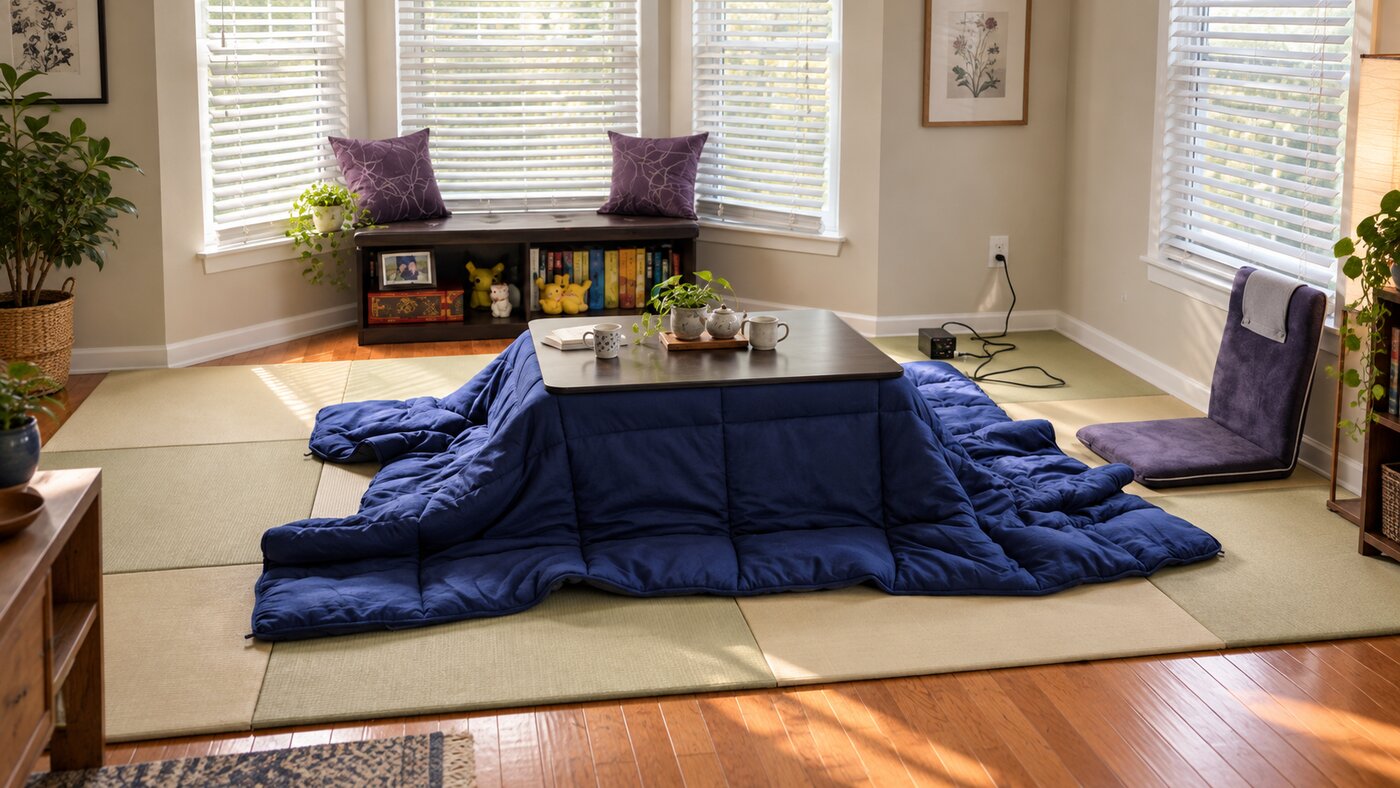
If you've ever stayed in Japan and fallen in love with a kotatsu, you might have wondered about recreating the experience back home. If you haven't tried one, maybe the idea of combining a low table, a comforter, and a heater mounted underneath sounds enticing.
What are my choices?
There are three ways to recreate the kotatsu experience in the US: (1) purchasing a ready-to-assemble kit with a 120V heater included, (2) a DIY table with a 120V heater purchased separately, or (3) a DIY table with a 100V heater and a step-down transformer to safely operate it in the US.
120V options
After years without any 120V options, kotatsu heaters designed for US power became available again in recent years. As of September 2026, a 400W PaletteLife quartz unit with an on-unit variable knob is the only 120V kotatsu heater readily available in the US. It sells for about $160 on Amazon, with shipping estimates several weeks out. It works fine, but it is one of the most basic configurations, and equivalent 100V models from Japan cost much less even with US shipping.
KEN Japan and BJDesign sell ready-to-assemble kotatsu tables with 120V heaters on Amazon in the US. The 29.5"x29.5" KEN JAPAN KB-75US(BK) is $229 as of September 2026. The 29"x29" BJDesign Japanese Kotatsu Heated Table (B09HTX2G2V) is around $400 and uses a wood frame and wood tabletop for a more traditional furniture feel. Larger BJDesign models are also available at higher prices.
100V - many options!
The rest of this guide focuses on the many 100V options available in Japan. Why bother when 120V heaters are available in the US? The 100V models give you more heating technologies, better control options, and up to 600W of heating power. They also give you more flexibility in table size, whether you want something larger or smaller than the common 29"x29" US options, but that usually means building or adapting the table yourself.
How can kotatsu heaters vary?
The three types of kotatsu heaters
There are three types of kotatsu heaters - quartz, halogen, and carbon. Each offers different heating performance and emits a different mix of infrared wavelengths.
Quartz heaters warm up more slowly but provide even heat. They emit primarily far-infrared radiation, which is readily absorbed by the body and is commonly used in infrared saunas, where heating can promote sweating, vasodilation, and increased circulation. Quartz has the shortest element life of the three, at about 5,000 hours. Quartz heaters are the standard option and are available in 300, 510, or 600 watts.
Halogen heaters heat up in seconds and produce a visible orange glow. They emit primarily near- to mid-infrared radiation, which penetrates farther into skin and underlying tissue than far-infrared and can produce deeper localized warming and increased blood flow. Halogen elements last substantially longer than quartz, at about 8,000 hours. Halogen heaters are the fast-heating option and are available at 600 watts.
Carbon heaters also heat up quickly and produce a softer visible glow. They emit primarily mid-infrared radiation, which penetrates deeper into tissue than far-infrared and can promote local warming and circulation. Carbon also provides more even heating than halogen, has a similar roughly 8,000-hour element life, and offers very high radiant efficiency. Carbon models are available at 500 watts.
For more information on the different types of infrared radiation and their effects on the human body, see this review of infrared radiation and skin physiology.
I personally recommend halogen and carbon. Quartz heaters can still make sense if your house is actually cold as balls, like many Japanese homes that lack central heating. But if we're going to the trouble of importing a Japanese heater, we might as well do something different. Quartz heaters are common in the US, halogen heaters are far less common, and carbon heaters are pretty much unheard of.
Control types
All current kotatsu heaters offer variable heat control, but the way you adjust them varies.
An on-unit variable knob is the cheapest and most basic control. It uses an analog dial, and the cord still provides on/off functionality, but temperature adjustments have to be made by feel since the knob is under the table.
A handheld variable knob on the cord also uses an analog dial, but lets you see and adjust the temperature setting without reaching under the table.
An IC (integrated chip) controller on the cord is the most advanced control option and is only offered on halogen and carbon heaters. It uses status LEDs that are easy to see in the dark and offers five discrete heat levels instead of a continuously variable analog dial. Additional functions include quick-start heating, which runs the heater on high for five minutes before returning to the previous setting, and ECO mode, which Metro says reduces power consumption by about 15% when running on high. Never plug an IC-controlled 100V heater directly into a US 120V outlet; the overvoltage can permanently damage the controller electronics.
Lastly, one Yamazen model combines a variable knob on the cord with a motion sensor. If no movement is detected for 30 minutes, the heater enters standby and automatically turns back on when movement resumes. If nobody returns for another hour, it shuts off completely.
Which kotatsu heater should I buy?
For the full model comparison and prices, including US shipping, see Kotatsu Part 1.5: Which kotatsu heater should I buy?.
EDITOR'S PICKS: For a quick recommendation, I'd choose Metro's MCU-501E(DKB) (Amazon JP) for 500W carbon heating or MHU-601E(DKB) (Amazon JP) for 600W halogen heating. Both have a fan and handheld temperature control.
Step-down transformers
Step-down transformers are widely available on Amazon US and convert 120V household power to the 100V required by Japanese appliances. Avoid choosing one rated at exactly the same wattage as your kotatsu heater, since that leaves little margin for operating variation. Allow at least 10% headroom, with 20-30% preferred, especially for inexpensive Chinese-made transformers, which can have optimistic power ratings or inconsistent manufacturing.
For more information on transformers, see Transformers: Running Japanese electronics safely in the US.
What's next?
Aside from the heater, you'll also need a suitable table and a non-flammable blanket, typically polyester. These will be covered in Part 2, when I finally get around to building my own kotatsu table at home.
Links
- http://www.kotatsu.metro-co.com/general_product_cat/replacement-heater/ - Metro's official kotatsu website
- https://www.kotatsu.metro-co.com/our-kotatsu/